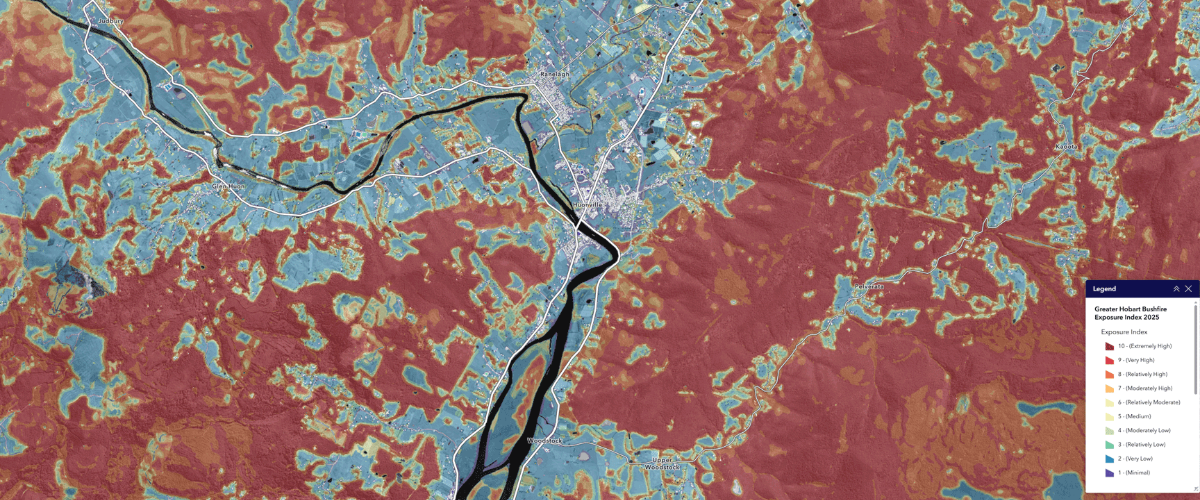

Before the next fire season, many organisations face the same challenge: identifying where severe fire is most likely, which buildings are most exposed, and where mitigation efforts should be prioritised first. Broad hazard maps can provide context, but preparedness planning requires more detailed and refreshable intelligence at the asset level.
Geoneon’s wildfire workflow addresses that gap by using refreshable satellite and geospatial data to produce two planning-grade outputs: a Wildfire Severity Index (WSI) that maps potential fire severity across the landscape, and a building-level Wildfire Exposure Index (WEI) that helps identify which assets sit within the highest wildfire exposure environments.
(This article is based on our IAC 2025 conference paper AI-Driven Wildfire Severity and Exposure Mapping: From Satellite Data to Actionable Insights)
Executive Summary
Wildfire planning often lacks a refreshable, asset-level view of where severe fire is most likely and which buildings are most exposed. Geoneon addresses that gap with two linked outputs: Wildfire Severity Index (WSI) for landscape-scale severity potential, and Wildfire Exposure Index (WEI) for building-level exposure.
In Greater Hobart, the workflow assessed about 94,000 buildings, with 4,225 buildings, or 4.5%, falling into higher exposure bands. In Bhutan, the same system assessed more than 400,000 buildings, with 24,221 buildings, or 5.9%, in higher exposure bands.
Validation against post-fire ΔNBR shows that high-severity fire tends to occur in areas ranked highly by WSI.
The workflow combines three underlying severity signals: vegetation structure and fuel continuity, terrain-driven fire intensification, and long-term climate dryness. These components are integrated into a continuous severity surface and then discretised into comparable exposure classes designed for operational planning and communication workflows.
1. The decision problem
Wildfire risk is increasing in many landscapes, shaped by both worsening fire conditions and continued expansion of development into flammable environments. For decision-makers, however, the central problem is not simply acknowledging that wildfire risk exists. It is identifying where severe fire is most likely to occur under the given landscape conditions, where that severity signal intersects with buildings, and how those patterns can be monitored consistently enough to support mitigation and preparedness planning.
Many existing wildfire tools are either designed for event-scale spread simulation or constrained by coarse or slowly refreshed fuels inputs. Geoneon’s work addresses that gap with an operational, asset-centred approach that uses routinely refreshed, globally available data to produce planning-grade severity and building exposure layers.
Event-scale fire spread models are valuable during active incidents, but preparedness planning often requires a stable baseline that can be refreshed routinely, compared over time, and linked directly to buildings and communities before a fire occurs.
2. What this work enables
Using routinely refreshed satellite and geospatial inputs, Geoneon can now generate wildfire severity and building exposure layers that make it possible to identify high-exposure buildings at metropolitan and national scale, rank suburbs and jurisdictions by concentration of exposure, target fuel treatments and defensible-space programmes more precisely, and compare wildfire exposure consistently across places and over time.
This matters because preparedness decisions are rarely made at the level of a regional hazard map alone. They are made around assets and specific geographies. A workflow that can screen building exposure, highlight concentrations along the wildland-urban interface, and feed web maps or APIs is immediately more useful for resilience planning than a broad hazard surface.
Because outputs are discretised into comparable classes, the workflow also supports clearer communication between technical and non-technical stakeholders. Instead of interpreting raw continuous surfaces, planners and decision-makers can work with stable severity and exposure bands that are easier to compare across jurisdictions and reporting periods.
3. Core insight
Vegetation structure, especially fuel continuity, is the dominant driver of wildfire severity, and that can now be measured at a useful resolution using AI and satellite data. In practical terms, severe fire potential is strongly shaped by whether vegetation is sparse or continuous, low or woody, fragmented or connected across the landscape.
In wildfire behaviour terms, isolated vegetation patches and continuous fuels do not behave the same way. Landscapes with dense and connected vegetation can support more sustained and severe fire behaviour than fragmented vegetation systems with equivalent total biomass. One of the central ideas in our workflow is therefore that fuel continuity matters as much as fuel presence.
The Geoneon workflow derives vegetation structure from a learned tree-probability surface combined with NDVI and EVI, producing a 10 metre vegetation layer that can be refreshed from global Earth observation inputs. This gives the severity model a stronger and more updatable basis than a generic hazard overlay alone.
The vegetation layer is generated by combining spectral vegetation indices with an AI-derived tree probability surface produced from satellite imagery. NDVI contributes a broad vegetation greenness signal, while EVI improves sensitivity in denser vegetation conditions and reduces sensitivity to atmospheric and soil effects. These signals are then combined with tree probability outputs to distinguish woody vegetation from lower vegetation classes.
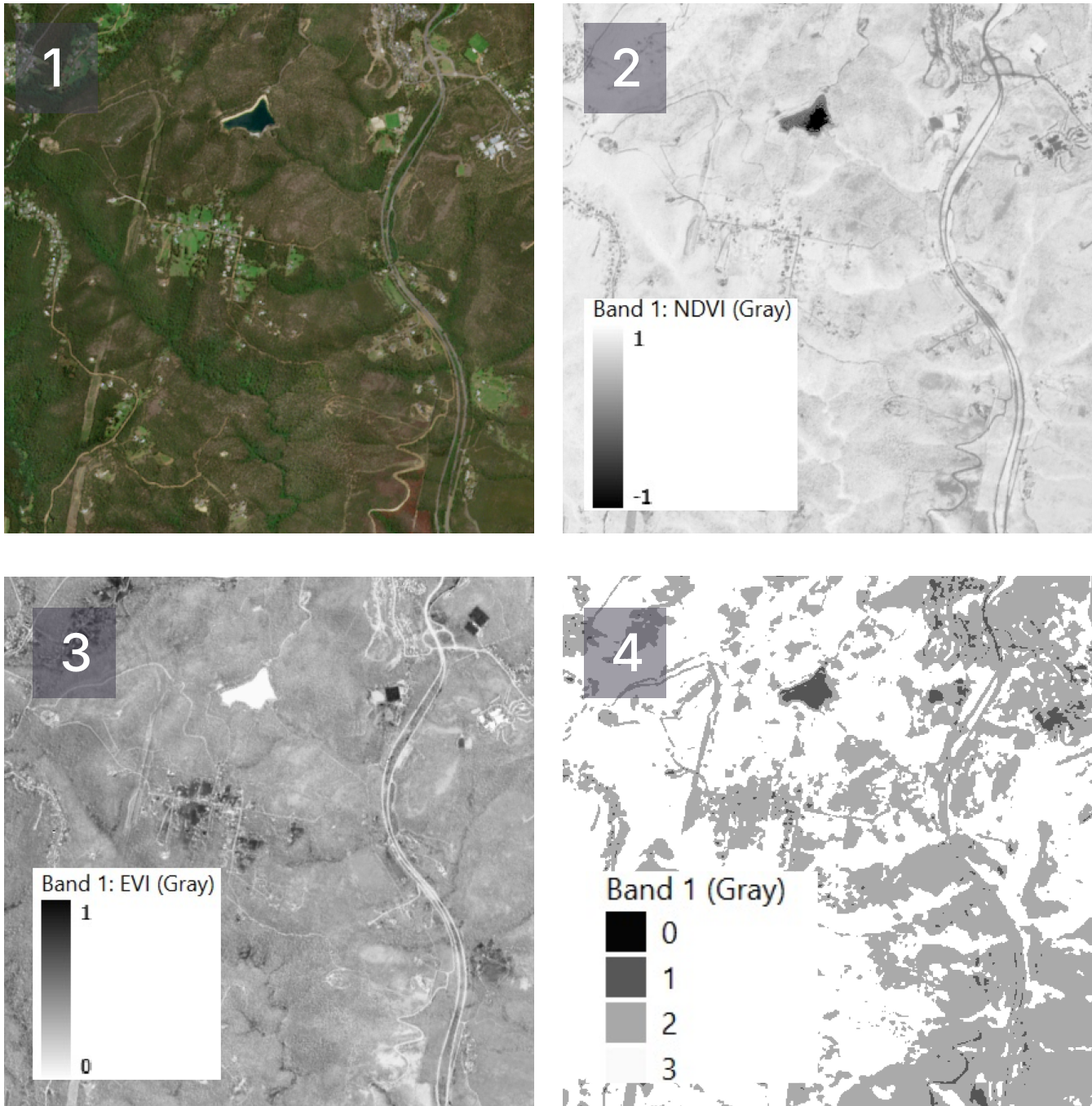
Fig. 1. Vegetation mapping workflow (1) Sentinel-2 L2A RGB (true-colour) over the study area, atmospherically corrected surface reflectance at 10 m. (2) NDVI map [−1,1], highlighting vegetation greenness. (3) EVI map (0–1), emphasising canopy signal with reduced soil/atmospheric influence. (4) Model output (4 classes) derived from tree probability and spectral thresholds: No data, No vegetation, Other-than-trees (low vegetation), Trees.
Rather than evaluating vegetation pixel-by-pixel in isolation, the workflow aggregates vegetation structure across neighbourhood areas of roughly one hectare. This creates a fuel continuity signal that better reflects how fire behaves across connected vegetation landscapes rather
4. The approach
4.1 System overview
The workflow combines four main environmental inputs, vegetation, topography, climate, and buildings, with Sentinel-2 imagery underpinning the vegetation component. Each component is scaled into a comparable range before weighted integration into the final WSI surface. From these, it produces two outputs: the Wildfire Severity Index (WSI) and the Wildfire Exposure Index (WEI).
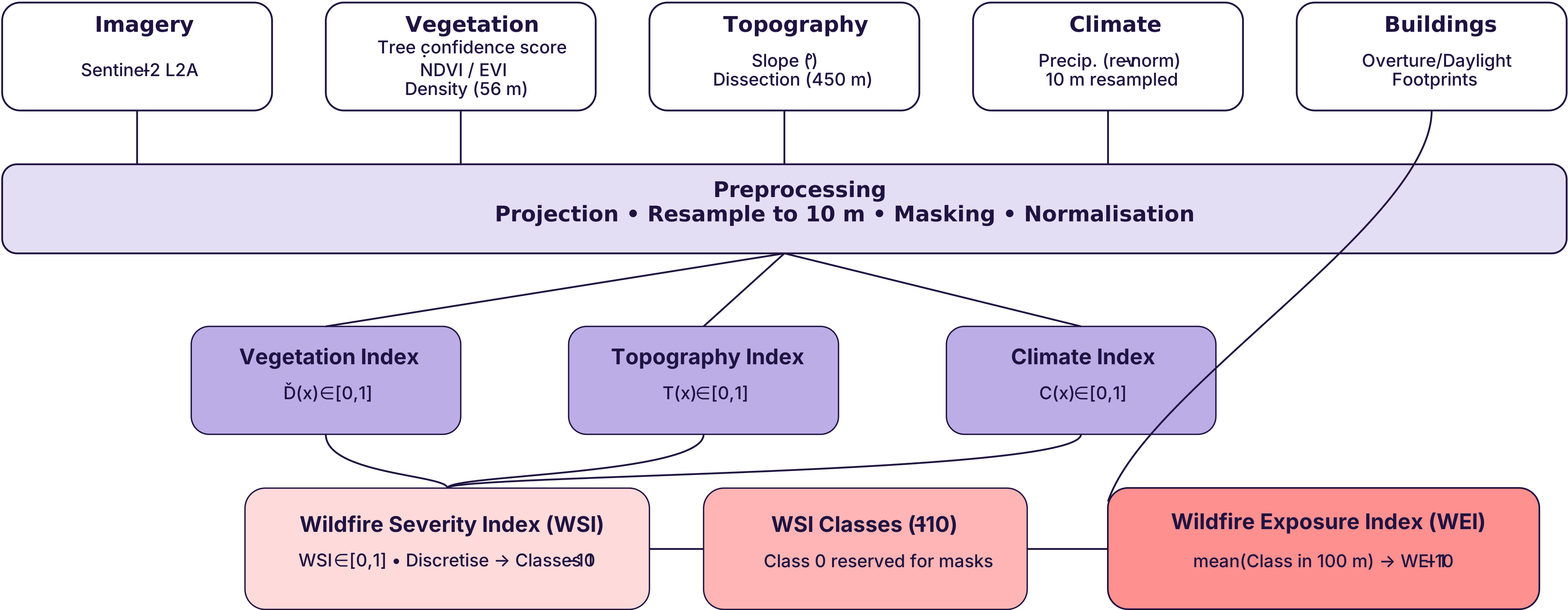
Fig. 2. Geoneon Wildfire Data Stack – inputs, processing, and outputs
The WSI combines weighted vegetation, topographic, and climate signals into a continuous severity surface before discretisation into planning-grade classes for mapping comparison. In the reference implementation, vegetation structure is the dominant component weight, reflecting its strong influence on severe fire behaviour potential.
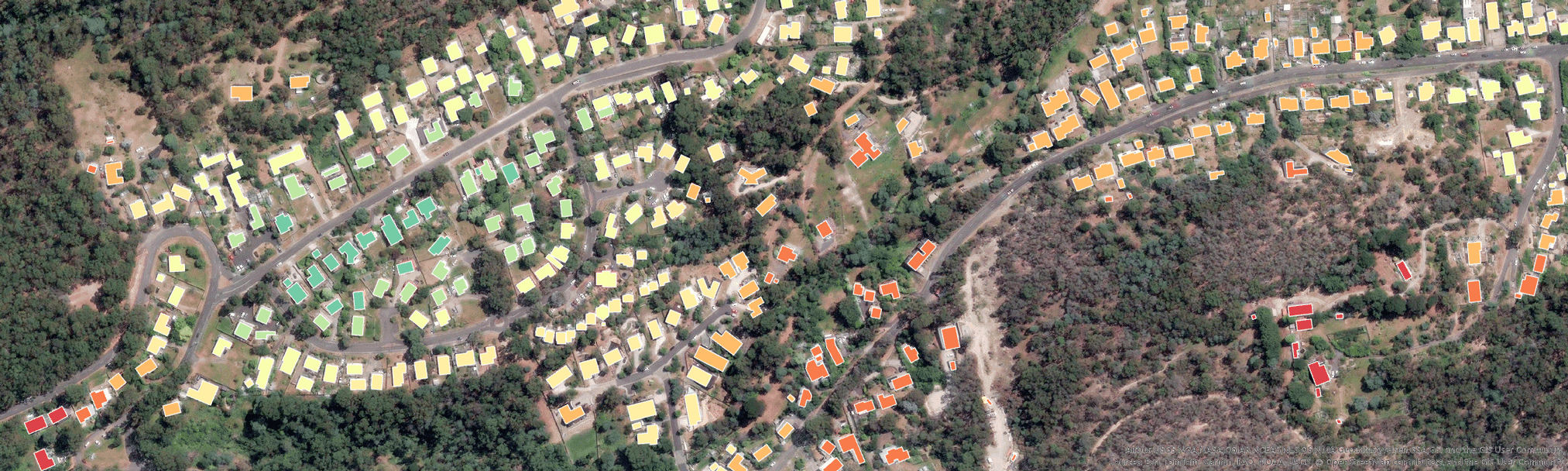
WEI is calculated for each building as the mean WSI class within a 100 metre radius, then binned into exposure classes.
The topographic component incorporates both slope and local terrain variation. Slope is important because steeper terrain can accelerate fire spread and intensify fire behaviour. Local terrain variation contributes an additional measure of landscape complexity associated with fire behaviour dynamics.
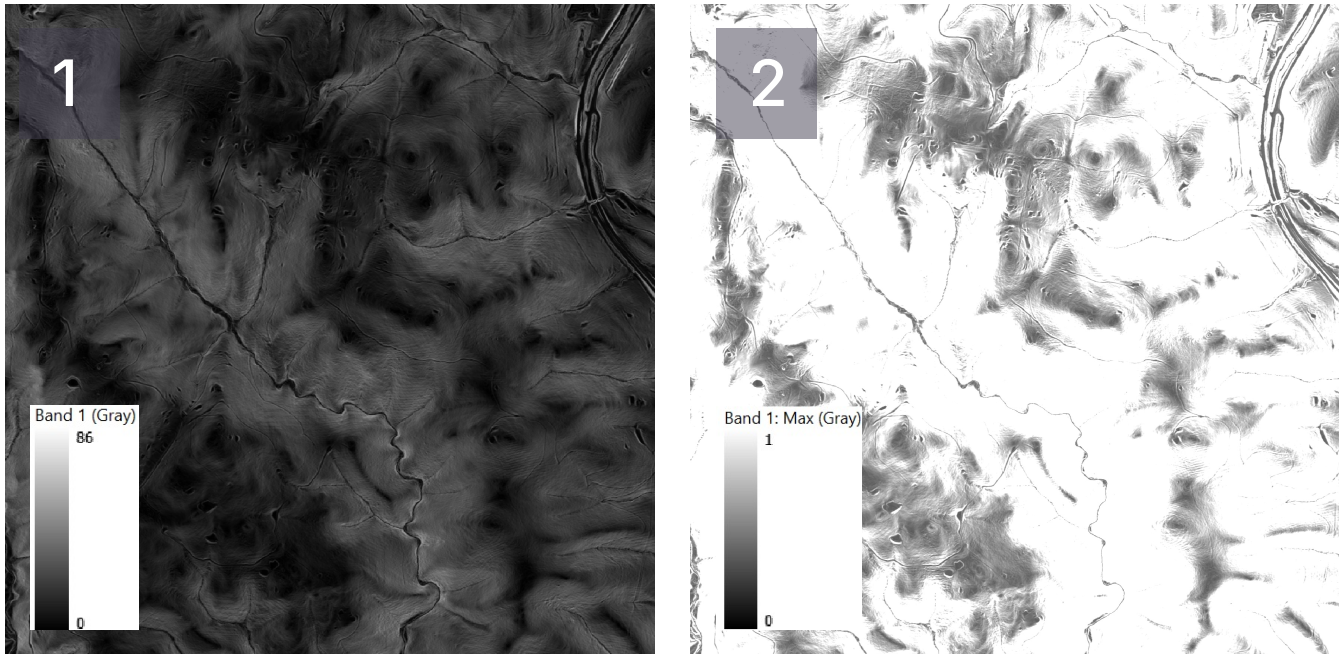
Fig. 3. Topographic controls on potential fire behaviour (10 m). (1) Slope (degrees) derived from the DEM; (2) Topography index combining the normalised slope and local relief (dissection).
The climate component acts as a long-term dryness modifier derived from precipitation climatology. Rather than representing short-term weather conditions, it provides a background indication of how persistently dry and fire-receptive a landscape may be over longer periods.
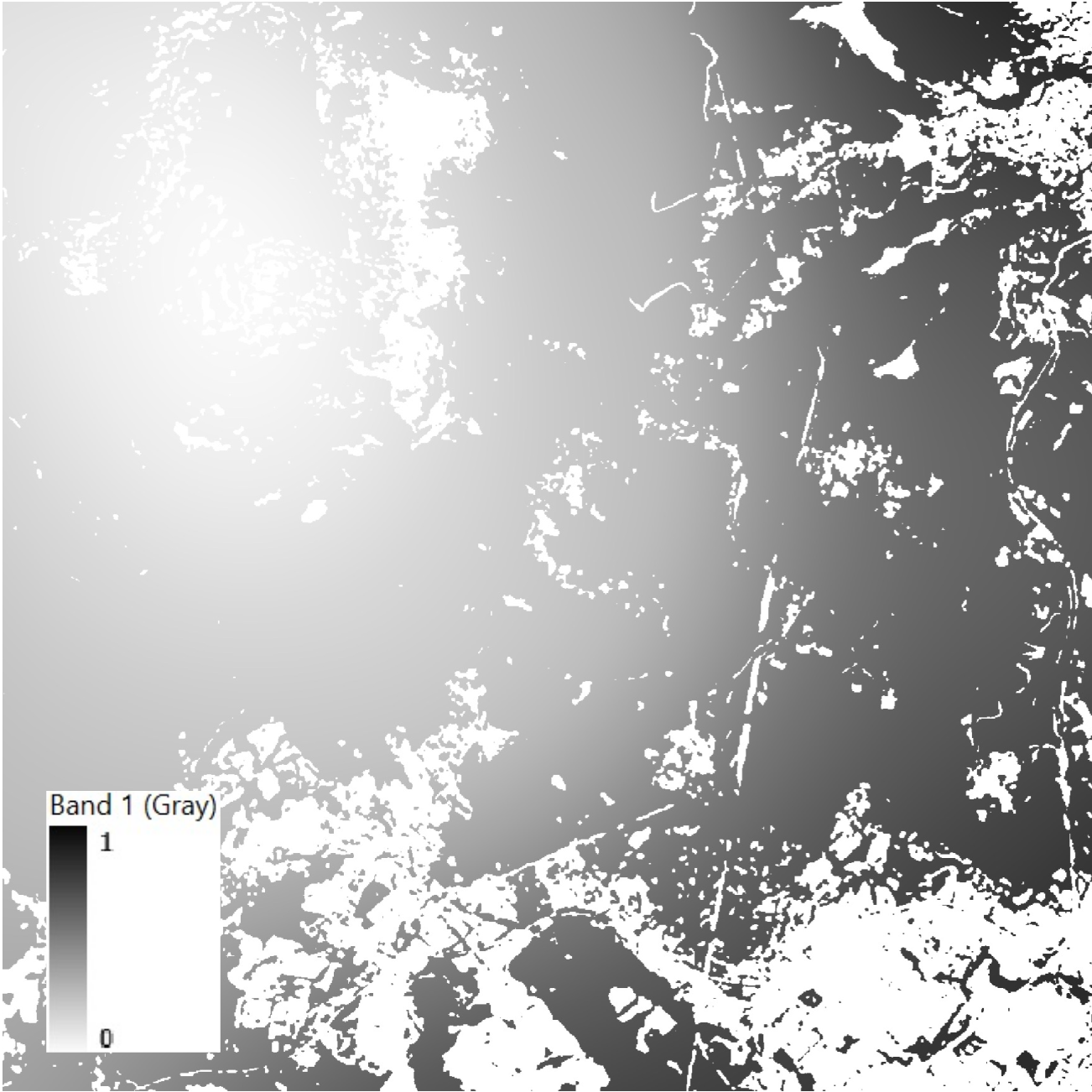
Fig. 4. Climate dryness layer (10 m). the climate modifier derived from long-term precipitation is applied primarily over vegetated pixels to emphasise fuel related effects.
Rather than stopping at a landscape-scale severity surface, the workflow carries the signal through to assets, which makes the output highly relevant to preparedness and mitigation planning.
4.2 Key design choices
Several design choices distinguish the approach. First, it is a static severity model, not an event simulation model. Its purpose is to show where severe fire is most likely if it occurs, given background landscape conditions, rather than predicting fire timing or spread on a particular day.
Second, it relies on global, refreshable inputs, including Sentinel-2 Level-2A imagery and quality-controlled building footprints, which makes repeat production feasible.
Third, it is asset-centred: exposure is explicitly calculated around buildings using a 100 metre neighbourhood rather than inferred only from general hazard context. The exposure calculation itself is intentionally localised. WEI is calculated from the average WSI class within a 100 metre radius around each building centroid. This reflects the importance of nearby fuel continuity in shaping structural exposure within wildland-urban interface environments.
Fourth, outputs are discretised and comparison-friendly, with WSI and WEI published as classes that can be interpreted more easily in planning, reporting, and communication workflows.
This discretisation step is important operationally. Rather than publishing only raw continuous values, WSI and WEI are grouped into comparable classes. This reduces sensitivity to minor local variation while making outputs easier to interpret across reporting, prioritisation, and communication workflows.
Together, these choices show the logic of the system. The aim is not to maximise methodological complexity. It is to produce an interpretable planning layer that is technically defensible, refreshable, and usable.
5. What we found
5.1 Where exposure concentrates
In both case studies, exposure concentrates where development meets continuous fuels. This concentration pattern is consistent with wildland-urban interface dynamics, where buildings located adjacent to continuous vegetation systems experience substantially different exposure conditions than structures embedded within more fragmented urban landscapes.
In Greater Hobart, we identified strong concentrations around peri-urban interfaces such as the Wellington Range foothills and localities in Kingborough and the South Arm area. This is a useful planning result because it points directly to where targeted mitigation is likely to be more effective.
5.2 How much exposure exists
In Greater Hobart, the workflow assessed approximately 94,000 buildings across 132 suburbs. Of these, 4,225 buildings, or 4.5%, fell into the higher exposure bands. In Bhutan, the same system assessed more than 400,000 buildings, with 24,221 buildings, or 5.9%, falling into higher exposure bands. These are decision-relevant numbers because they quantify the scale of potential exposure in a form that can support prioritisation and resource allocation.
Importantly, these results are not simply regional hazard estimates. Because exposure is calculated directly around buildings, the workflow produces asset-level metrics that can be aggregated upward into suburb, district, or jurisdiction-level planning views without losing the underlying building-scale signal.
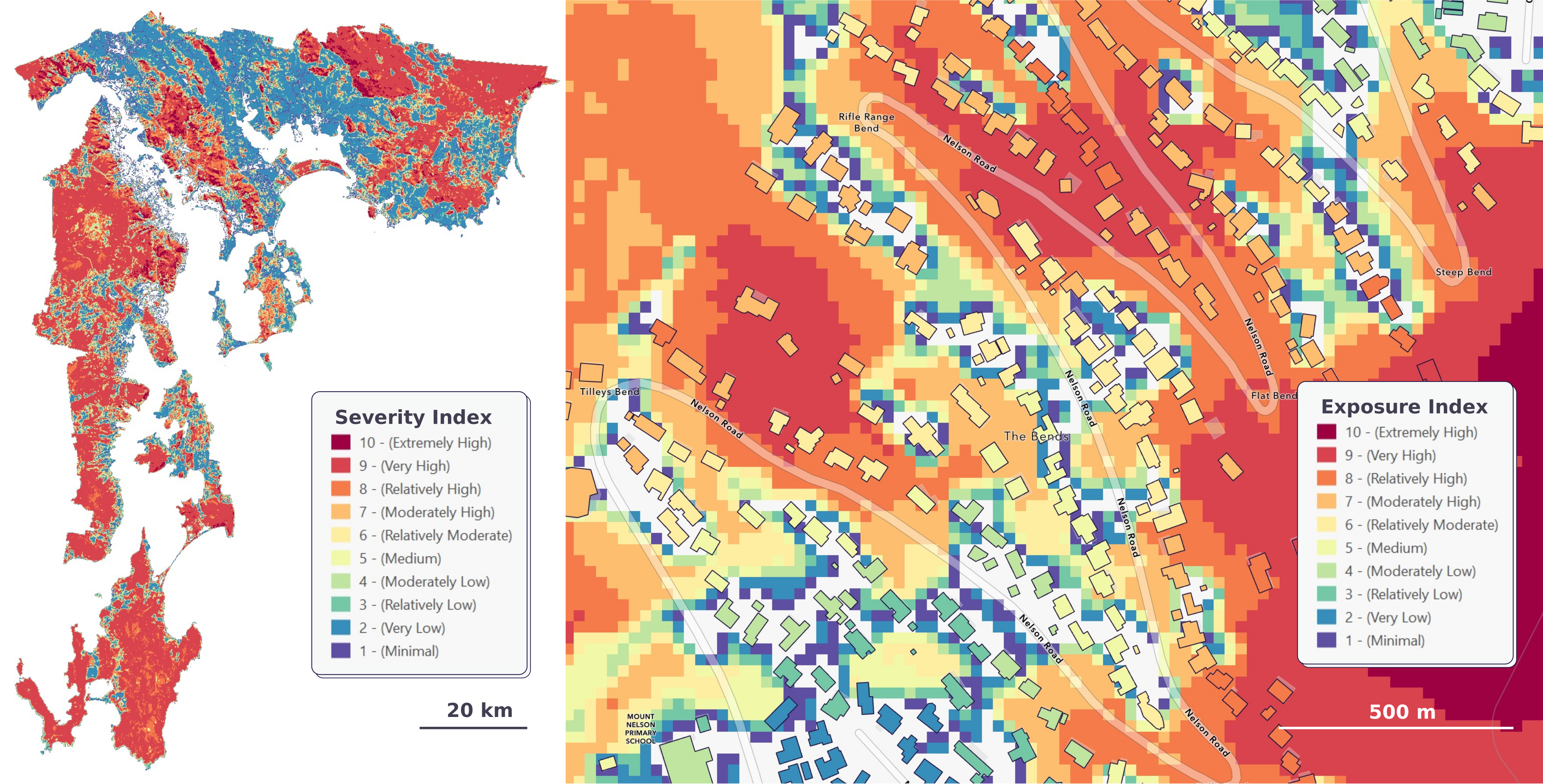
Fig. 5. Greater Hobart WSI (left) and WEI map extract (right) illustrating a peri-urban hotspot and surrounding building exposure classes (1–10).
5.3 Transferability
The fact that the same workflow was applied in both Greater Hobart and Bhutan is important. These are very different settings in terms of geography, settlement patterns, and landscape structure. Yet the method still produced interpretable, asset-centred outputs without bespoke re-engineering for each case. That supports the claim that this is not merely a local model, but a transferable system for refreshable wildfire exposure analysis.
6. Validation
6.1 Does it match reality?
To test whether the WSI aligns with real-world fire behaviour, we compared the model to post-fire burn severity for two historical wildfire events, namely the Dunalley fire in Tasmania in 2013 and the Busby’s Flat fire in New South Wales in 2019-2020.
This validation seeks to answer the question: do areas that later burn severely tend to coincide with areas already identified by WSI as having high severity potential?
The comparison uses ΔNBR, a standard post-fire spectral severity metric derived from pre- and post-fire imagery. High ΔNBR values indicate areas where fire caused stronger vegetation and surface change impacts.
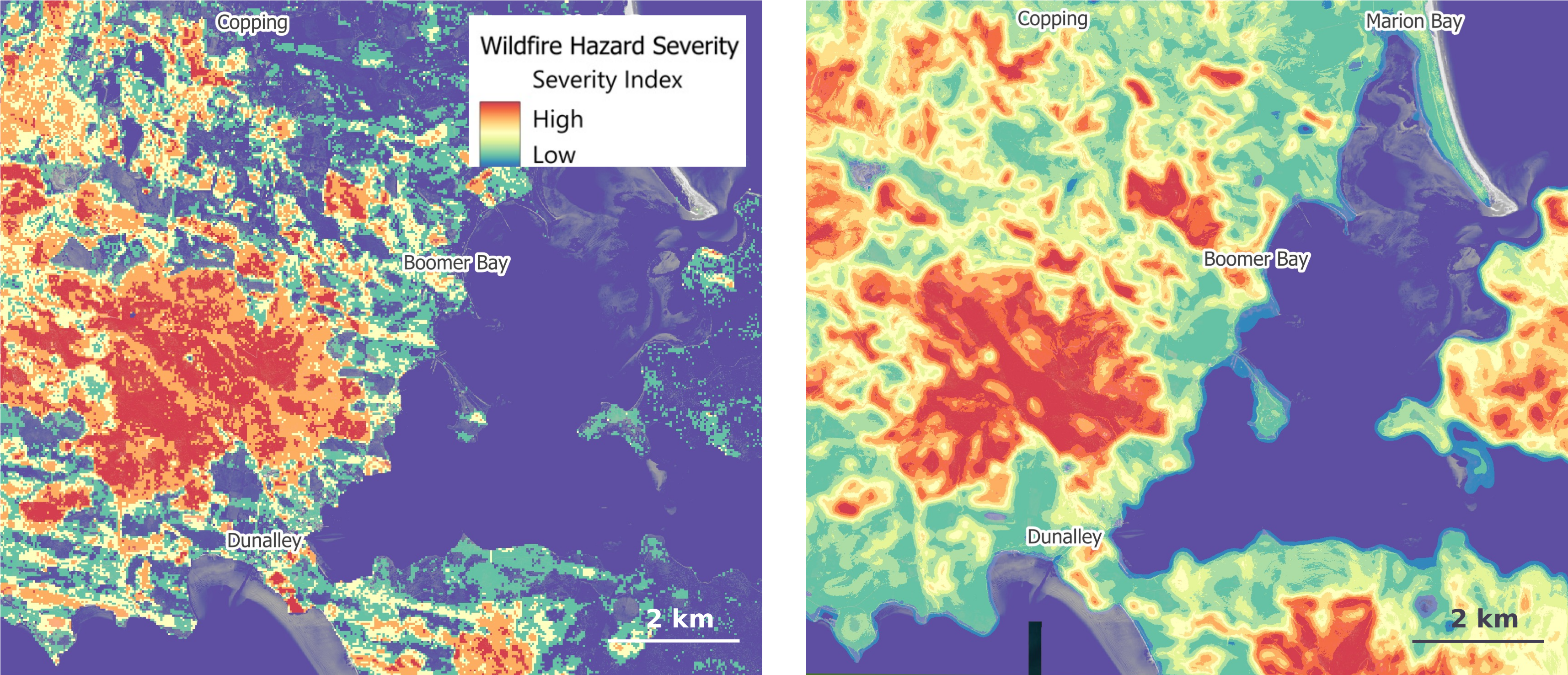
Fig. 6. Dunalley, Tasmania (2013): ΔNBR vs WSI. Left: ΔNBR burn-severity classes from pre/post event ARD scenes. Right: WSI deciles (10 m). High-severity ΔNBR patches coincide with areas ranked High by WSI (≈ 65% of ΔNBR-High pixels are WSI-High; > 90% are ≥ Moderately High). Resolution differences (20–30 m ΔNBR vs 10 m WSI) explain residual smoothing along edges.
In the Dunalley, Tasmania case, about 65% of ΔNBR-high pixels fell in the top WSI class, and more than 90% fell into the moderately high or higher WSI classes. This is a meaningful result: areas that burned severely tended to coincide spatially with areas that the static WSI had already ranked highly. A similar pattern of local agreement within intensely burned pockets was found in the Busby’s Flat case.
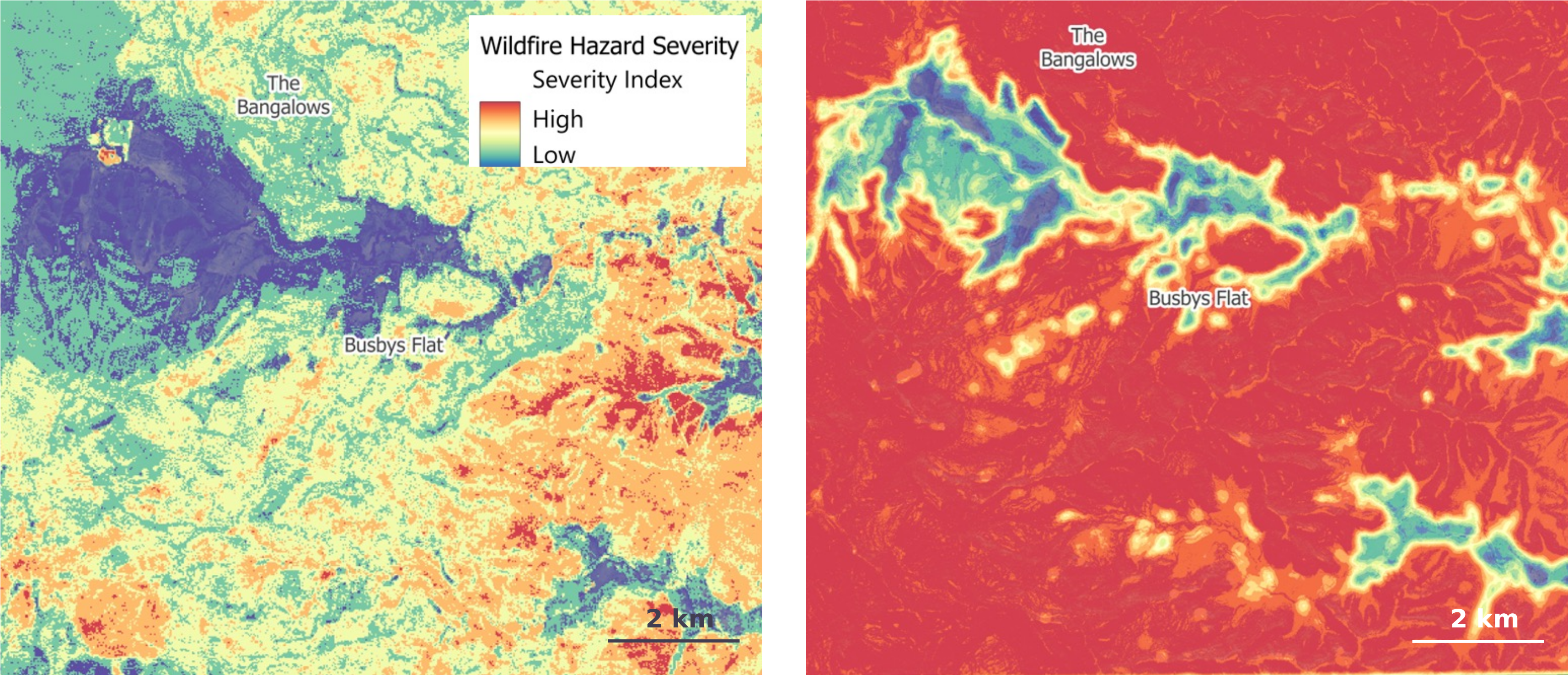
Fig. 7. Busby’s Flat, New South Wales (2019–2020): ΔNBR vs WSI. Left: ΔNBR burn-severity classes from pre/post event. Right: WSI deciles (10 m). At landscape scale, WSI highlights widespread high potential severity (~80% of vegetated pixels), while realised High ΔNBR covers ~10% of the event footprint; within intensely burned pockets, spatial agreement is strong. This illustrates WSI as a static “where-if-it-burns” layer.
6.2 Scope and intended use
WSI and WEI are planning and preparedness layers that provide a view of the wildfire severity potential and building exposure. It does not model ignition likelihood, suppression dynamics, or short-term weather-driven fire behaviour. Instead, it focuses on identifying where severe fire is most likely if it occurs under underlying landscape conditions, providing a decision-support baseline that can complement operational forecasting and fire spread models.
7. Implications for practice
For government and preparedness teams, the WSI and WEI can support fuel treatment prioritisation, defensible-space programmes, suburb or district ranking, mitigation planning, and community risk communication. Because the outputs are asset-centred and discretised, they can also support more defensible programme design and easier explanation of why one area is prioritised ahead of another.
The workflow may also be relevant for organisations managing geographically distributed assets, including utilities and insurers, because it provides a consistent way to identify where buildings and infrastructure intersect with higher wildfire severity potential. By linking severity conditions directly to assets, the approach supports more targeted geographic screening than broad regional hazard mapping alone.
8. Operational characteristics
A major reason this work is operationally relevant is that it is designed around repeatable production. The workflow uses open and versioned datasets, including Sentinel-2 Level-2A imagery and quality-controlled building footprints, and is structured around straightforward refresh cycles and comparable outputs over time.
This comparability matters because preparedness planning often depends less on single snapshots than on the ability to monitor changing exposure conditions consistently across years, jurisdictions, and reporting cycles.
This answers an important operational question: can an organisation actually use this? The answer is yes, because it is not a one-off research exercise. It is a refreshable data pipeline whose outputs can be integrated into existing planning and resilience workflows.
9. Limitations
The current framework does not incorporate ignition likelihood, suppression dynamics, or short-term fire weather, so it should not be interpreted as a probability forecast. Because it is a static model, it may overrepresent the extent of severe-fire potential relative to what occurs in any single event. Transfer across biomes and seasons can also introduce domain shift in the vegetation model, which means ongoing quality assurance remains important. Finally, exposure is simplified through the use of a 100 metre buffer and does not yet incorporate structure-specific vulnerability such as materials or defensible-space condition.
10. What comes next
The most valuable next step is to extend this stable baseline with dynamic fire-weather information so that the workflow can move from susceptibility toward likelihood without losing comparability through time.
Beyond that, improved exposure modelling and sensitivity testing around the exposure radii, as well as the addition of asset-vulnerability characteristics, such as building materials or defensible space, are practical next steps that are set to deepen decision usefulness rather than simply adding complexity.
The broader contribution of the work is clear. Geoneon uses AI-derived vegetation structure and global satellite data to produce refreshable, building-level wildfire exposure maps that enable targeted mitigation, clearer prioritisation, and more defensible planning across geographies.