


Across Western Australia’s Great Western Woodlands, regional councils manage vast areas with small teams and limited resources. Deciding where to prioritise bushfire mitigation means understanding the landscape, the communities within it and the infrastructure that keeps them connected.
Geoneon has been named a recipient of the 2026 NRMA Insurance Help Fund Climate-Smart Innovation Grants. The support will help deliver the Great Western Woodlands Bushfire Resilience project, bringing spatial evidence into decisions about where preparedness and mitigation work should be focused.
From landscape conditions to practical priorities
The project will combine satellite-derived vegetation information with terrain, climate and asset data to map where bushfires could be most severe and which communities and infrastructure are exposed.
The assessment will consider buildings, roads, rail and other critical infrastructure.
An interactive webmap and analytical report will bring the findings together. These outputs are intended to help councils and infrastructure operators identify priority locations for fuel management, access maintenance and infrastructure protection, and provide evidence for planning, budget decisions and funding applications.
Connecting regional analysis with local knowledge
The region’s transport corridors connect Western Australia with the eastern states and the port of Esperance. Disruption can affect freight, essential supplies, businesses and access for remote communities.
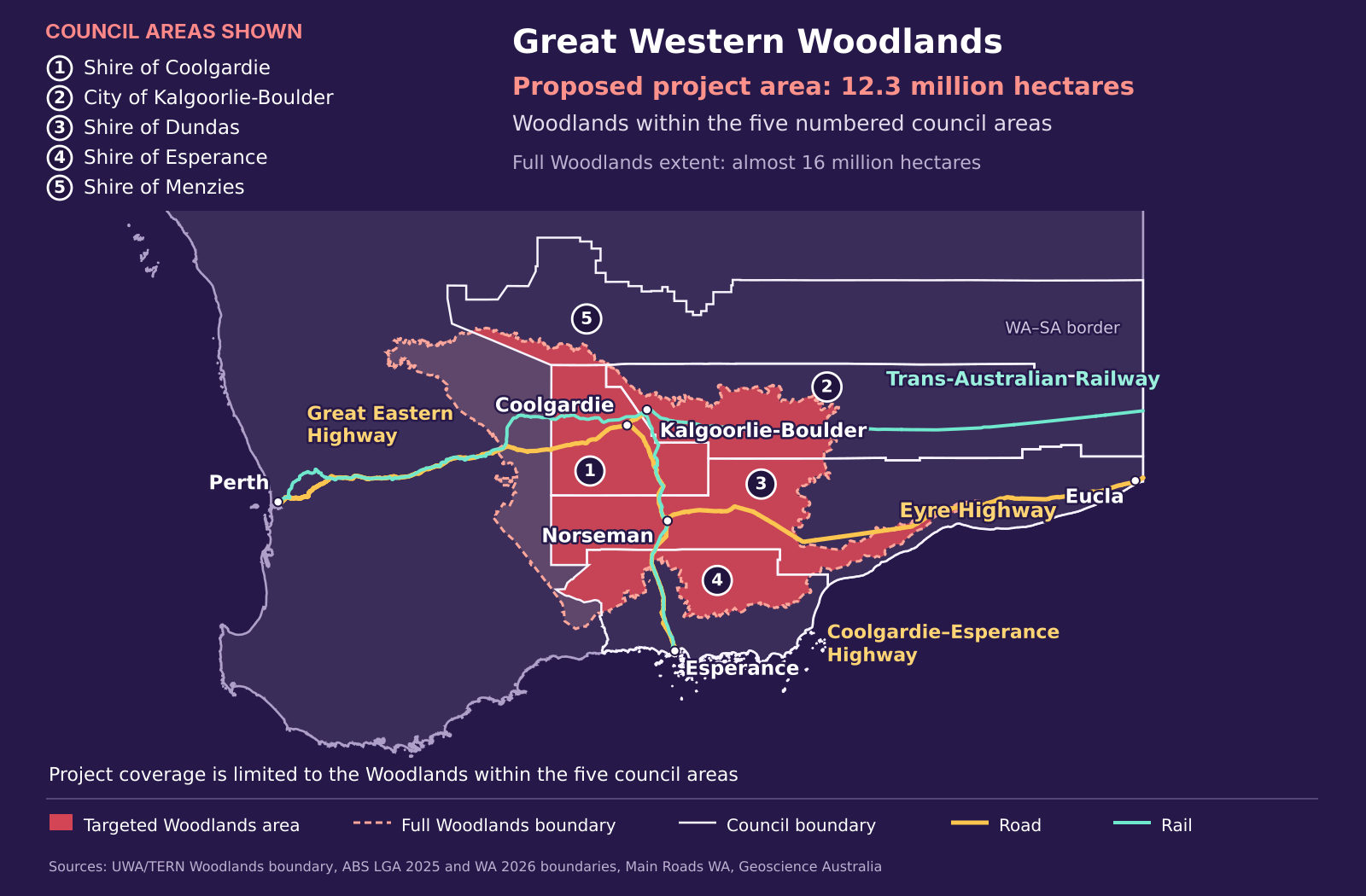
Proposed project area within the Great Western Woodlands, showing council boundaries and major road and rail corridors. Map: Geoneon; underlying sources credited on the figure.
The project will review findings with local stakeholders so the analysis can be considered alongside knowledge of local conditions and practical constraints. This will help turn regional mapping into priorities that can inform action on the ground.
Delivery of the webmap and report is planned for June 2027. The aim is to give regional decision-makers a clearer basis for directing limited resources before a fire occurs.
Support for climate resilience
This year, eight recipients will share in $500,000 in grant funding across two streams: Growth Grants and Emerging Founder Grants.
NRMA Insurance will work with Climate Salad on tailored support programmes, connecting recipients with industry experts, partners and customers to help accelerate deployment of their solutions.
We thank NRMA Insurance and Climate Salad for supporting this work, and congratulate the other 2026 grant recipients.
Learn more about the NRMA Insurance Help Fund.